
The money side — materials, POs, dispatch & accounts
Purchasing, Dispatch and Accounts on a job, and what each is for.
What this is for
Three tabs carry the commercial side of a job. Purchasing is what it needs bought or sent out. Dispatch is how it leaves the building. Accounts is the money: what was quoted, what has changed, what has been invoiced and what it actually cost.
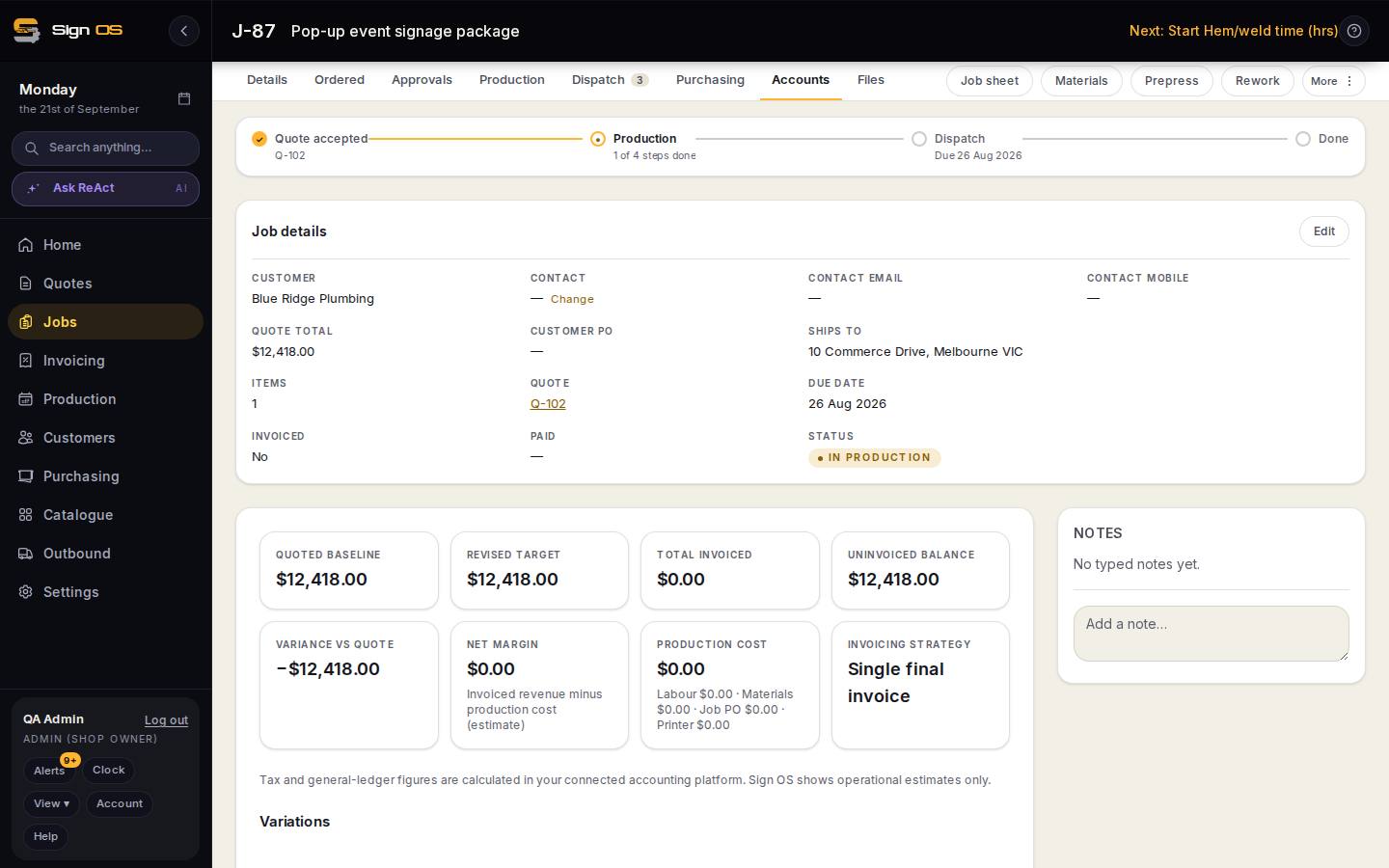
What is on this screen
Each part of the screen above, top to bottom, and what changing it affects.
Purchasing tab
- Materials for this job — Material · Needed · Reserved · Picked · Shortfall · PO
- What the recipes need against stock, and the PO covering any shortfall.
- Purchase orders · + Create job PO
- POs linked to this job for back-costing.
- Work sent out
- Each step with In-house or a supplier. Marking a step as done by a supplier stops it using your capacity and shows it on Out at suppliers.
Dispatch tab
- How it goes out — Installation · Delivery · Client pickup
- As set on the quote; Save how it goes out changes it.
- Install checklist · Add task
- Book install date, confirm site access, permits — ticked as done.
- Fulfilment · Dispatch address · Install required · Install notes · Save dispatch
- Where it goes and what the installer needs; the job moves to Dispatched when its docket is marked gone out on Outbound.
- Site documents — SWMS · Dispatch manifest
- Open SWMS → drafts the safety document; the manifest is the printable packing list.
Accounts tab
- Quoted baseline · Revised target · Total invoiced · Uninvoiced balance · Variance vs quote
- What was quoted, what it became after variations, what has been billed and what is left.
- Net margin · Production cost
- Invoiced revenue minus production cost (labour, materials, job POs) — an operational estimate, not the books.
- Invoicing strategy
- Single final invoice, or staged.
- Variations · Add variation
- Approved scope changes.
- Invoices · Generate invoice
- Drafts and synced bills; Generate opens the invoice page.
Step by step
- 1
Job details, at the top: press Edit to record the customer's PO number, the ship-to address, due date, project name and status.
- 2
Purchasing tab: Materials for this job lists what the recipes need, what is reserved, picked and short, with a PO column. + Create job PO raises a purchase order linked to the job for back-costing. Work sent out marks a step as done by a supplier — it stops using your capacity and shows on the Out at suppliers board.
- 3
Dispatch tab: How it goes out (installation, delivery, client pickup) as set on the quote, an install checklist, dispatch address and install notes, plus the SWMS and the printable Dispatch manifest. The job moves to Dispatched when its docket is marked as gone out on Outbound.
- 4
Accounts tab: the Quoted baseline, Revised target after variations, Total invoiced, Uninvoiced balance, Net margin and Production cost (labour, materials, job POs). Variations and Invoices live here; Generate invoice opens the invoice page.
Tips & gotchas
- Tax and ledger figures come from your accounting software. The Accounts tab is an operational estimate, not the books.
- Net margin is invoiced revenue minus production cost, so it reads $0 until an invoice exists — that is not a loss, it is unbilled.